Xona Space Systems has introduced Pulsar Verified, a new ecosystem partnership program designed to help receiver manufacturers, chipset integrators and test equipment developers validate hardware against the company’s Pulsar low-Earth orbit (LEO) navigation signals. The program comes as Xona’s Pulsar-0…
ArkEdge Space Inc., a Tokyo-based micro-satellite developer, has opened a new facility in the Shinkiba district of Koto-ku, Tokyo, to support the development and manufacturing of lunar navigation demonstration satellites. <p>The post ArkEdge Space establishes Shinkiba lab to manufacture lunar…
The U.S. Space Force has ended an exploratory effort to add smaller, lower-cost navigation satellites to strengthen the existing GPS constellation, reports Space News. <p>The Space Force does not plan to move forward with on-orbit demonstrations of industy-designed smallsats under…
L3Harris has demonstrated a positioning, navigation and timing (PNT) solution for the U.S. Space Force’s Space Systems Command that is adaptable across platforms, fully reprogrammable on orbit and scalable to support more signals and increased power as PNT threats evolve.…
The U.S. Space Force’s Space Systems Command (SSC) has awarded Raytheon a $ 196.7 million contract extension for the GPS Next Generation Operational Control System (OCX) program — despite being years behind schedule. This latest award brings the total OCX…
The Pentagon’s first batch of new and more capable GPS satellites, part of the GPS IIIF program, is facing significant delays. The first batch is eight to eleven months behind schedule, which the U.S. Space Force attributed to manufacturing difficulties encountered…
CACI International has been awarded a ten-year contract valued at up to $ 450 million to support the Joint Navigation Warfare Center (JNWC), an operational center of U.S. Space Forces and the Department of Defense’s (DOD) center of excellence for…
Image: EUSPA The European Union Agency for the Space Program (EUSPA), in collaboration with the European Commission, has published a new version of the Galileo Open Service Signal in Space Interface Control Document (OS SIS ICD). The latest version, denoted…
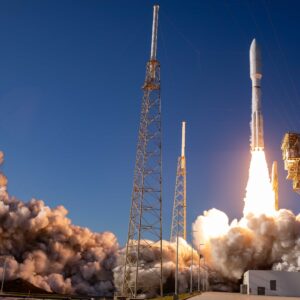
Image: SSC Space Systems Command (SSC), the National Reconnaissance Office (NRO), United Launch Alliance (ULA) and their mission partners successfully launched the “Silent Barker”/NROL-107 mission aboard an Atlas V rocket September 10, 2023, at 8:47 a.m. EDT from Space Launch Complex (SLC)-41…